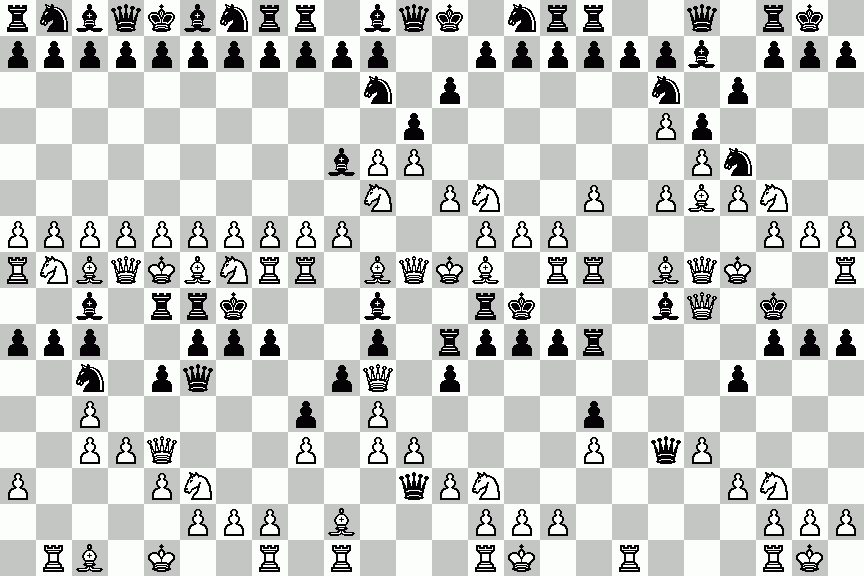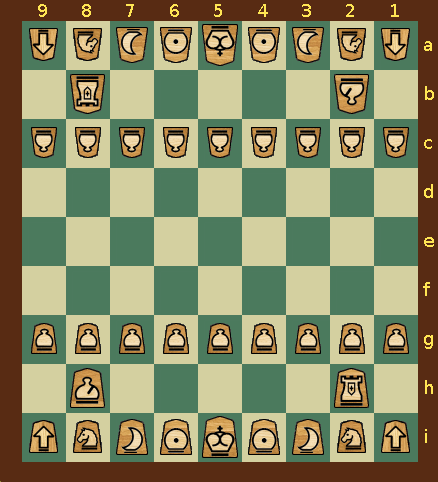
Above are two shogi sets, one with Japanese kanji, the other with Western pieces. For those familiar with chess, the lower picture would obviously be most useful. I will explain the rules briefly, and if anyone is ever interested, I could answer further questions.
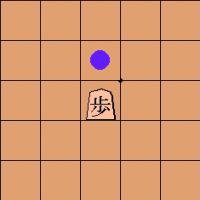
The front row is obviously occupied by pawns. A more accurate translation would be foot soldiers, but pawn will suffice. They move one step and only one step straight forward. They may not make a two step first move as pawns in Western chess may, and they attack the same way they move, as opposed to the Western pawn, which steps forward, but attacks at the forward diagonals. In our chess, two pawns face to face are immobilized. But in shogi, such is not the case, as they are both attacking each other.
Pawn:
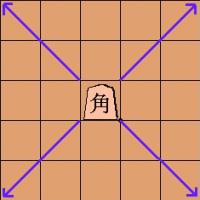
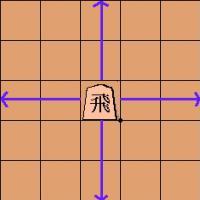
The second row is only occupied by two pieces at the start, the bishop and the rook. More accurate translations would be diagonal-goer and chariot, but again, the Western name is fine. These move just like in Western chess, but no special castling move applies to the rook in this game.
Bishop:
Rook:
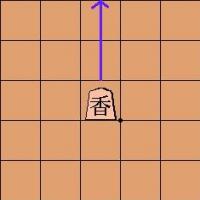
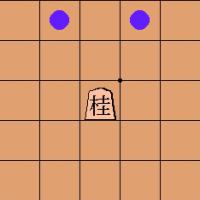
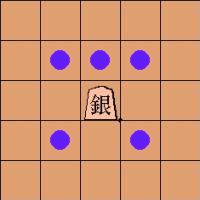
In the last row are several pieces, in order from left to right: lance, knight, silver general, gold general, king, gold general, silver general, knight, lance. There are more literal translations for these as well, but I can't remember them all. The knight though is better translated as horse, and the king is better called the jewel general, but for our sakes, we'll stick with the commonly used English names. The lance moves like a rook, but only in the forward direction. The knight moves like the Western knight, but only to the two forward squares, as opposed the 8 squares available to our knights. The silver general moves like a Western king, except not to the direct left, right, or back. The gold general moves like the Western king, except not to the backward diagonals. The king moves like the Western king, except there is no castling move.
Lance:
Knight:
Silver General:
Gold General:

King:
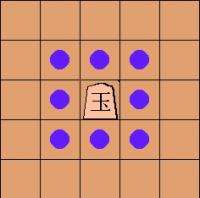
The object of the game is to checkmate the king, just as in American chess. A king must move out of check if able, the checking player must announce that he is checking the king, BUT the king may move into check, a sort of suicide move. In practice, this is never done and can be abandoned in favor of the Western rule.
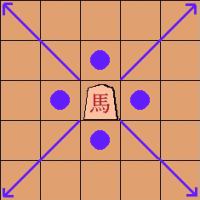
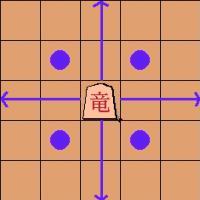
Note the the pieces on the back row are very weak. But there are a few pluses. First, most pieces can promote. Promotion is done at the end of a move, as long as a piece has any part of its move take place in the promotion zone. The promotion zone consists of the 3 ranks closest to the enemy player. Promotion is always optional, unless no further legal moves can be made by that piece if it is not promoted, i.e. a pawn that moves to the last rank or a knight on one of the last two ranks. These pieces then must promote. So to reiterate, if a piece ends its move in the promotion zone, or even if it starts in the promotion zone and then leaves it, it may promote at the end of the turn. Since shogi pieces are flat, promotion is done by flipping the pieces over to the other side and revealing what is on that face (written in red ink, while the umpromoted value is in black). Pawns, lances, knights, and silver generals all promote to pieces that may have different names, but are identical in move to the gold general (and thus may be called gold generals upon promotion--see the illustration above for guidance). The bishop promotes to a dragon horse, which moves just like the bishop, or on square forward, backward, left, or right. The rook promotes to the dragon king, and thus moves like a rook, or one square to any adjacent diagonal.
Dragon Horse:
Dragon King:
What really makes this game interesting, in spite of so many weak pieces, is the ability to "drop" captured pieces. Note that all pieces are of the same color, and that the distinction between armies depends on the direction they are pointing. If you have captured your enemy's piece, it is now a part of your army. For your turn, instead of moving a piece, you may drop a captured piece onto almost any vacant square, subject to the following restrictions:
-a piece must be dropped at its unpromoted value, meaning if you captured a promoted lance (which moves like a gold general), you may only drop it as a lance.
-a dropped piece must be able to legally move at some point afterward, meaning you may not drop a pawn or lance on the last rank, or a knight on the last two ranks.
-you may only have one pawn per file, meaning you cannot drop a pawn on any square in front or behind another friendly pawn. You may of course share your pawns' files with enemy pawns, and you may also share drop pawns in the same file as friendly promoted pawns (acting as gold generals). You just can't have two of your own unpromoted pawns in the same file.
-a pawn may not be dropped to deliver checkmate.
Look what this leaves available! Any other piece may be dropped to checkmate the enemy king! A piece may be dropped in the promotion zone, and the next time it moves, it is guaranteed promotion!
I love chess, and it is often hailed as a perfectly balanced, well analyzed, exceedingly complex game. Indeed I love the piece moves and the nature of the game. But shogi is, in reality, more complex! When two pieces in chess are exchanged, the game gets simpler. For example, I trade my knight for an enemy knight; now there are fewer available moves and positions. Well, in shogi, if you trade pieces in this manner, you actually have more available moves, as now these pieces can be placed on almost any vacant square on the board! The game has been well developed and analyzed. Frankly, I'm not very good at it. But it's fun, it's interesting, and it's different. I can't say that I love it more than Western chess, but I'd probably call it a tie. They are different games, but I love them both! I urge others to check shogi out.